
Public or private boundary
Check the trunk location and ACTmapi context where a property meets a street, park or other public edge. Canopy overhang does not establish ownership.
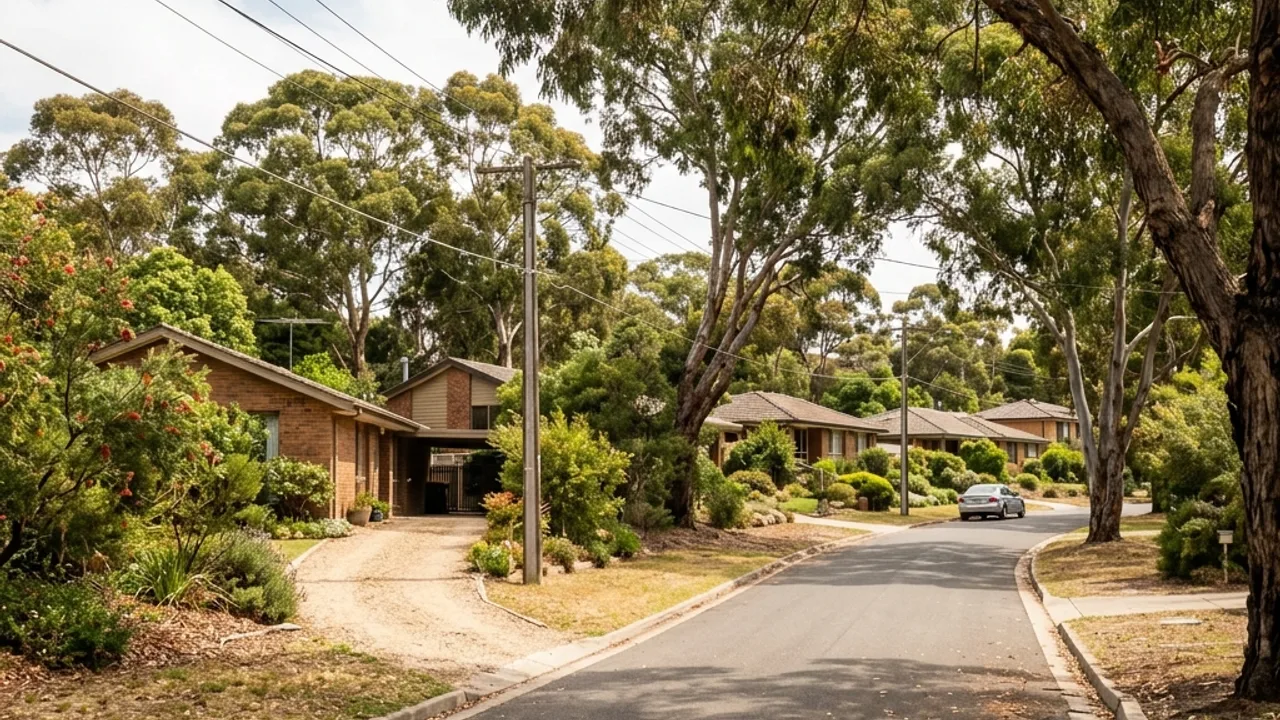
Yarralumla 2600
Large established trees are part of Yarralumla's landscape; protected status, neighbour interfaces and public-land boundaries need early checking.
Start with the actual site
A Yarralumla tree decision can involve large established canopy, a neighbour interface and a nearby public-land boundary. Ownership, protected status and the case for pruning or assessment should be resolved before size alone drives a removal request.
Locate the trunk against the property boundary and use current ACT information to distinguish private from public land. All public trees are protected, and private trees can qualify for protection through size, registration or other conditions. A large tree is not automatically protected, removable or unhealthy merely because of its age or scale. If the question is condition, risk or development impact, ask for an assessment that states the evidence and limitations before a work method is selected.
Where private work is appropriate, show the whole canopy, neighbour relationship, access gates, structures and the space available for lowering. If pruning could preserve the tree while resolving a clearance or deadwood issue, name that outcome and compare it separately with full dismantling. The written quote should set out approvals assumptions, method, neighbour access, branch and log handling, stump finish and provider proof. A complete scope is more useful than a price derived from height or postcode.
Property-level questions
Check the trunk location and ACTmapi context where a property meets a street, park or other public edge. Canopy overhang does not establish ownership.
Record species and measurements where safe, then follow current City Services tests. A quote cannot promise approval or replace the owner’s statutory step.
Show overhang and shared edges, identify any adjoining access needed and decide whether pruning, assessment or removal best answers the actual concern.
A clearer written enquiry
Tree size prompts measurement and status checks, not an automatic claim about protection, hazard or removal suitability.
Canopy, fences and access points are shown before the proposed method relies on adjoining land or leaves an overhang question unresolved.
Evidence can inform the decision, while the eventual provider still writes the access, method, waste and site-finish scope for the chosen operation.
Local orientation
Weston Park, Yarralumla Shops and Government House are distinctive points around Yarralumla, with Novar Street, Hopetoun Circuit and Adelaide Avenue shaping local approaches. Deakin, Curtin and Parkes lie around its wider setting. Established trees are prominent within the suburb's landscape, but each work decision remains site specific. A useful Yarralumla enquiry places the trunk against the boundary, identifies public-land and neighbour interfaces, and shows whether the access path and lowering area remain within land the owner can authorise for the proposed work.
Local work context
Near Weston Park, Government House or another public-land edge, a tree visible from a Yarralumla garden should not be treated as private from appearance alone. Use the address and boundary information, then photograph the trunk, fence and wider canopy together. Along Novar Street or Hopetoun Circuit, also show the side access and any neighbour area beneath overhanging branches. If the desired result is light or clearance rather than whole-tree removal, include the retained outcome in the brief. That keeps status, permission and pruning method ahead of a price discussion.
From photographs to written scope
A Yarralumla enquiry should first show where the trunk and canopy sit in relation to fences, verge, parkland and neighbouring land. A mature tree visible from a private garden is not proof that every limb or work area is privately controlled. Use ACTmapi and current City Services guidance for the initial screen, then obtain authoritative confirmation where the boundary or protected status remains uncertain. Keep that question separate from an assessment of condition or work method.
For a tree that proceeds to private scope, document the complete route and the retained landscape. Show gate widths, established planting, irrigation or garden surfaces that need protection, and the position available for controlled lowering and material staging. Ask the provider to state whether pruning, assessment or removal is proposed, why that activity matches the outcome, and what happens to branches, logs, stump and disturbed ground. A written exclusion should be as visible as an inclusion before quotes are compared.
Choose the work type
Plan the Yarralumla next step
Start the Yarralumla enquiry with ownership
Send boundary, whole-tree and access evidence so the correct government, assessment, pruning or removal route can be identified.
Site facts first
Tell us where the trunk sits, what outcome you need and whether public land, protected status, neighbour access or assessment remains unresolved.
Continue local planning
Local neighbourhood context
Deakin, Curtin, Parkes