
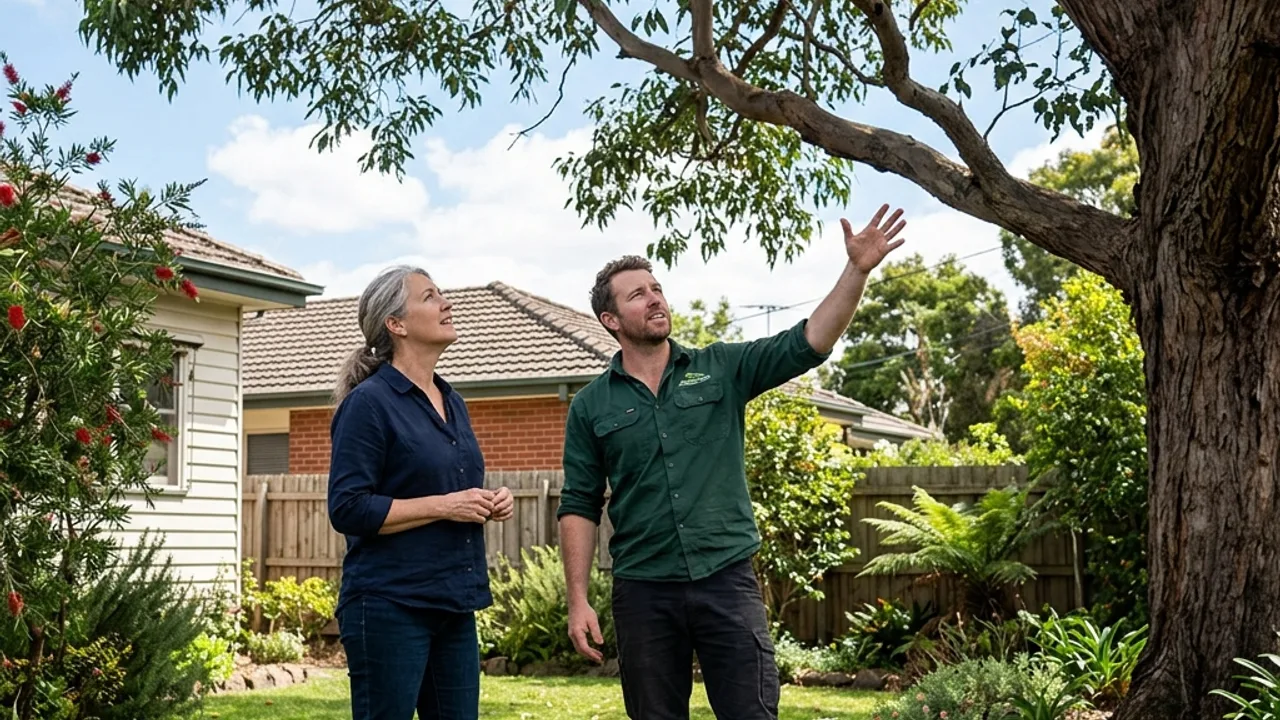
Current ACT routes, careful scope
Frequently Asked Questions: Tree Removal Canberra
Use the questions to separate statutory checks, immediate safety, service choice, property evidence and provider proof before comparing written scopes.
22 current questions
Tree removal Canberra questions by decision
The answers provide general preparation only. City Services, Access Canberra, emergency services, the electricity network and the actual provider remain responsible for the decisions within their authority.
Question group 01
Cost
How much does tree removal cost in Canberra?
There is no reliable price from height alone. Quotes vary with trunk and canopy size, species, access, rigging, nearby buildings or power lines, approvals, waste handling and whether stump grinding is included. Send photographs and request a written itemised scope.
How big of a tree would cost $1,000 to remove?
A dollar figure cannot be mapped safely to one height. Two trees of similar size can require different rigging, machinery, access, traffic controls, electrical-line precautions, approvals and waste handling. Use a site-specific written quote.
Question group 02
Compliance
Do I need approval to remove a tree in Canberra?
Approval is required before removing or carrying out major pruning on a protected private tree under the Urban Forest Act 2023. Check the tree in ACTmapi and use current City Services guidance before authorising work.
What makes a private tree protected in the ACT?
A private tree may be protected if it reaches an ACT size threshold, is a qualifying dead native tree, was planted under a recent canopy contribution agreement or is on the ACT Tree Register. City Services provides the current tests and measurement guidance.
Do I need approval to remove a dead tree in Canberra?
It depends on the tree. A qualifying dead native tree can still be protected, while a dead non-native tree may not be protected by size. Confirm species, measurements and current status with City Services rather than assuming dead means exempt.
Can I prune or remove a street tree myself?
No. All public trees are protected and residents must not trim, prune, plant or remove street trees. Report public-tree concerns through Access Canberra or Fix My Street.
How can I tell whether a tree is on public or private land?
City Services recommends checking ACTmapi using the address and aerial imagery. Boundary uncertainty should be resolved before a contractor scopes the work.
Question group 03
Safety
Can tree work be done near power lines?
Tree work near overhead or underground electrical lines must comply with current WorkSafe ACT and network requirements. Disclose every nearby line and service before attendance; do not attempt the work yourself.
What happens with storm-damaged or urgently dangerous trees?
Keep people away from the area, avoid fallen or low lines, and contact emergency services for immediate danger. For an urgent protected private tree, City Services directs owners to Access Canberra on 13 22 81.
Question group 04
Process
What should I include in a tree removal enquiry?
Include the suburb, clear photographs of the whole tree and trunk, approximate height or trunk measurement, access width, nearby roofs, fences and services, visible defects, ownership and whether stump work and waste removal are required.
Will the branches and logs be taken away?
Waste handling varies. A quote should say whether branches are chipped, logs are removed or left, mulch is retained, stump grindings are removed and final clean-up is included.
Question group 05
Removal vs Pruning
Should I remove a tree or prune it instead?
That decision depends on the tree's health, structure, location, protected status and the outcome you need. A qualified assessment may identify selective pruning or risk reduction as an alternative to removal.
Question group 06
Pruning
What is the difference between tree pruning and tree lopping?
Tree pruning uses selected cuts for a defined objective. Lopping commonly means indiscriminate cutting between branch unions and can harm structure and health. Ask for the pruning objective and method in writing.
What is deadwooding?
Deadwooding is selective removal of dead, dying or broken branches. The scope should state the parts of the canopy to be addressed and any exclusions caused by access or protected-tree rules.
Can I request tree trimming in Canberra rather than full removal?
Yes. Describe the practical issue - dead branches, clearance, light, structure or storm damage - so selective pruning can be considered before removal.
Question group 07
Stump
Is stump grinding included with tree removal?
Often it is a separate line item. Ask the quote to say how deep the stump will be ground, whether surface roots are included, what happens to the grindings and whether backfilling or site repair is included.
Does stump grinding remove every root?
No. Grinding removes the visible stump and major surface material to an agreed depth; it does not normally excavate the entire root system.
Question group 08
Assessment
When is an arborist assessment useful?
An assessment is useful when the cause of decline or risk is uncertain, removal approval may be needed, a development could affect a protected tree, or competing pruning and removal options need to be compared.
Question group 09
Choosing
Who is the cheapest tree removal provider in Canberra?
A cheapest-provider claim cannot be verified from a search result. Compare written quotes for the same tree, stump, machinery, approvals, waste, clean-up and exclusions, then verify the actual provider's qualifications and insurance.
What insurance and qualifications should I ask a provider to prove?
Ask the actual provider for current public liability and worker cover where applicable, relevant arboriculture qualifications, experience with the work method and any required electrical-line authorisation. Check that the evidence names the operator and remains current for the proposed work.
Question group 10
Timing
How long does tree removal take?
A simple accessible tree may be completed in part of a day, while a large dismantle, constrained site, approval process or traffic and power-line interface can take longer. Timing should be confirmed after inspection and approvals.
Question group 11
Local
Do you cover Belconnen, Gungahlin and Tuggeranong?
The enquiry catchment covers Canberra's main urban districts, including Belconnen, Gungahlin, Weston Creek and Tuggeranong. Provider availability is confirmed for the specific suburb and scope.
Plan the next step
Still deciding what the tree needs?
Describe the tree, change or concern, ACT status, access and intended outcome. A useful response starts with the missing evidence, not an invented instant quote.