
People or property in immediate danger
Call 000 when there is an immediate threat to life or a serious emergency. Do not stand beneath damaged canopy, cross a barricaded area or attempt to move a suspended limb to improve access for photographs.
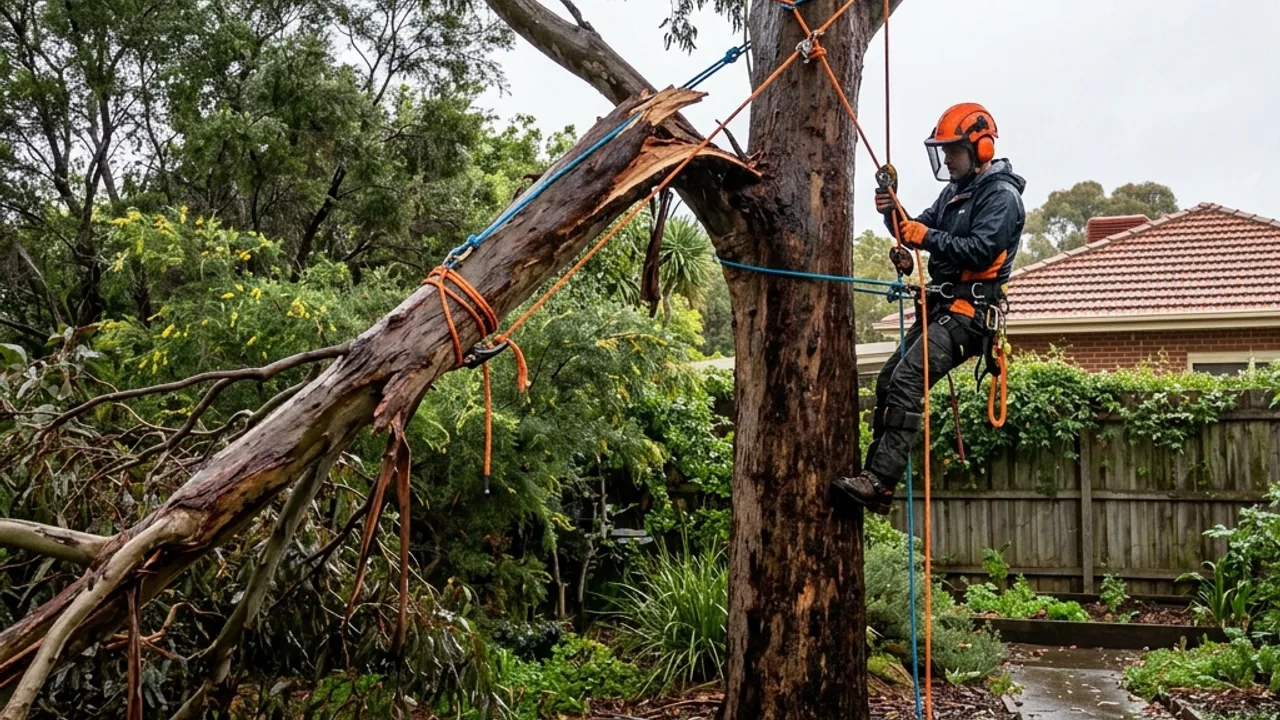
Immediate safety first, commercial follow-up second
Keep people away from a fallen, split or shifting tree and do not approach fallen or low electrical lines. Use emergency or government channels for immediate danger, then send site details only when a commercial follow-up is appropriate.
Clarify the work
Emergency tree work begins with exclusion, not inspection by phone. Move people and pets away from the area without entering the potential fall zone. Treat every fallen or low line as dangerous and do not touch the tree, a branch, a fence or other object that may be in contact with it. Call emergency services for immediate danger. A public tree or an urgent protected private-tree matter can also require the current Access Canberra or City Services route rather than a commercial form.
Once immediate danger is controlled, the remaining job may involve temporary make-safe work, removal of a failed section, full dismantling, access restoration or a later assessment. First contact should show the whole scene from a safe position, ownership if known, nearby lines and structures, blocked access and what has already occurred. No responsible response should promise attendance time, declare a tree safe from photographs or assume storm damage cancels approval requirements.
Decision points
The correct next action depends on people, electricity, ownership and whether the site can be kept clear. A written enquiry is not a substitute for emergency dispatch.
Call 000 when there is an immediate threat to life or a serious emergency. Do not stand beneath damaged canopy, cross a barricaded area or attempt to move a suspended limb to improve access for photographs.
Stay well clear and follow the electricity network or emergency-services direction. Tree work near overhead or underground electrical infrastructure requires specific controls and may require authorised people. Do not assume ordinary tree credentials cover every line interface.
Residents must not work on public trees. City Services directs urgent protected private-tree matters through Access Canberra on 13 22 81. Record the advice or incident reference so later commercial work can be scoped against the correct status.
Written inclusions
Urgent work needs a boundary between official response, temporary make-safe activity and the later removal, pruning, assessment or clean-up that completes the job.
Triage identifies what happened, the occupied target area, electrical or public-tree involvement and whether the area can remain isolated. It is a decision about the route and inspection need, not a promise that the entire problem can be diagnosed remotely.
Clearance may restore a driveway, path or building access after hazards are controlled. The scope should identify what material can be moved, where logs and branches go and whether stump, root-plate or structural damage remains for later work.
A cracked, hung or partly failed limb can require controlled access and lowering. Show its relation to the trunk and targets from a safe distance. The provider should inspect attachment, working position and exclusion requirements before choosing a method.
Make-safe work can be deliberately limited to removing immediate exposure or stabilising access. Put the temporary outcome and remaining tree work in writing so an urgent intervention is not mistaken for a complete pruning, removal or clean-up job.
From concern to scope
Keep people clear and use 000, the electricity network, Access Canberra or another official route when the situation falls within their role.
Only if it can be done without approaching the hazard, note the address, ownership, visible failure, blocked access, lines and structures involved.
Ask the actual provider to state what urgent action addresses and what assessment, removal, pruning, stump or clean-up remains afterwards.
Once conditions permit inspection, obtain a written method, approvals position, site controls, provider proof, material handling and completion criteria.
Questions that improve the brief
For immediate danger, call 000. Keep clear of electrical lines and contact the electricity network. Report public-tree hazards to Access Canberra, and use the ACT protected-tree route when urgent private-tree work needs approval.
A limited urgent intervention can leave assessment, pruning, full removal, stump work or waste for later. Naming that boundary prevents an incomplete emergency action being mistaken for finished work.
Ask the actual provider whether the site, hazard class, electrical interface and timing are within its capability before relying on an attendance plan.
Choose the next action
Ask what changed during the incident, which parts were made safe and which hazards or defects remain. The later written scope should distinguish debris clearance, selective pruning, assessment and whole-tree removal. If a root plate moved, a main stem split or an adjacent tree was struck, photographs from before the event and a daylight inspection may affect the final recommendation.
Do not compare urgent work only on the promise of speed. Confirm the proposed method, exclusion area, electrical and public-tree route, machinery, traffic or neighbour access, waste handling, qualifications, insurance and limits. A provider who cannot safely handle a particular line or access interface should say so and direct the correct escalation.
Define the later dismantling, stump and waste scope after immediate hazards and ownership questions are controlled.
Open guideUse evidence and stated limitations when the remaining tree condition or management decision is uncertain.
Open guideRead the immediate safety, electrical-line, public-tree and urgent protected-tree answers first, then prepare a commercial follow-up only when that route is appropriate.
Choose the suburb only for non-emergency local access prompts. Immediate danger, lines and public-tree matters use official channels first.
Plan the next step
Send urgent details only after safety routing
When the area can be kept clear and a commercial follow-up is appropriate, describe ownership, access and what happened, and note any safe-distance photos available to provide later.